Florida's Helmet Law and the $10,000 Rule: What Riders 21 and Over Need to Know
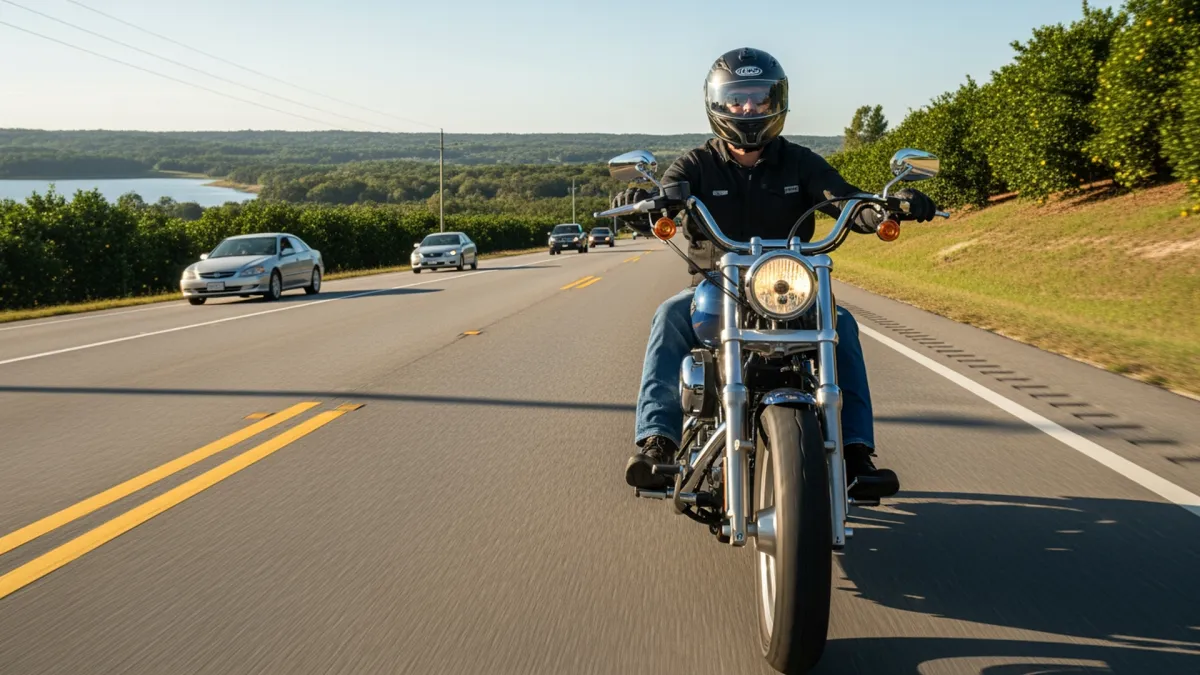
Florida is one of the states where an adult rider can legally ride without a helmet, and plenty of Central Florida riders do, feeling the wind on a clear run through the Clermont hills. What most of them do not fully realize is that the freedom comes with a dollar figure attached, and that the same choice which is perfectly legal on the road can be used against them in an insurance fight after a crash.
What the Law Actually Says
Florida's helmet statute draws a hard line at age 21. If you are under 21, you must wear a helmet that meets the federal DOT standard every time you ride, and there is no exception to buy your way around. If you are 21 or older, you may ride without a helmet, but only if you are covered by an insurance policy providing at least $10,000 in medical benefits for injuries from a motorcycle crash. No qualifying coverage, no legal helmet-free ride.
That $10,000 figure trips people up, because it is not the same as the PIP that comes on a car policy, and it is not automatic on a motorcycle. It is medical benefits coverage you have to actually carry on the bike or through another qualifying policy. Riding lidless without it is not the free choice some riders think it is. It is a violation.
Legal to Ride, Still Used Against You
Here is the part that catches riders off guard. Even when you meet the coverage rule and ride helmet-free entirely within the law, the at-fault driver's insurer will still bring your bare head into the conversation after a head or neck injury. They are not arguing you broke the helmet law. They are arguing you contributed to how badly you were hurt, and in Florida that argument has teeth.
- ✓ They separate the crash from the injury. The adjuster may concede the driver caused the wreck while claiming a helmet would have reduced your head injuries, trying to pin part of the harm on you.
- ✓ They push your fault percentage up. Every point of blame they move onto you shrinks what they owe, and it is a deliberate strategy, not an accident.
- ✓ They know where the cliff is. Since the 2023 reforms, a rider found more than 50 percent at fault in Florida recovers nothing, so the insurer's goal is to drag you across that line.
- ✓ It applies even to a legal choice. Riding without a helmet lawfully does not stop them from raising it. It just changes the argument they make about it.
The 51 Percent Bar Changes the Math
Before March 2023, Florida followed pure comparative negligence, meaning an injured rider could recover something even if they were mostly at fault, just reduced by their share. That is gone. Florida now uses modified comparative negligence with a 51 percent bar. If a jury or adjuster puts more than half the blame on you, you collect nothing.
That single change is why a helmet argument matters so much more than it used to. An insurer no longer needs to prove you caused the crash. They just need to build enough of a story around your choices, the helmet included, to nudge your share past the halfway mark. For a rider, that turns a legal decision into a legal exposure, and it is exactly the kind of argument that benefits from being answered by someone who does this for a living.
How Riders Protect Themselves
You cannot undo a helmet decision after a crash, but you can make sure the coverage and the record are on your side. A few steps go a long way.
- ✓ Carry the medical benefits coverage. If you ride helmet-free at 21 or older, confirm you actually have at least $10,000 in qualifying medical coverage, not just an assumption that you do.
- ✓ Keep under-21 riders in DOT helmets, always. There is no coverage workaround for younger riders, and a violation only hands the insurer more ammunition.
- ✓ Do not accept the fault story at face value. An adjuster's opinion about what a helmet would have prevented is an argument, not a medical fact, and it can be challenged.
- ✓ Get help before you talk percentages. Comparative-fault fights are won with evidence and medical testimony, not by arguing with the insurer on the phone.
Led by Moe DeWitt, DeWitt Law Firm in Orlando fights for injured motorcyclists. Reach out to their Orlando motorcycle accident attorneys anytime you need real answers.